


Healthcare Integration in the NHS: Fall Prevention and Gait Rehabilitation - Dynamic Metris Ltd
The NHS aims to be at the forefront of integrating innovative healthcare solutions to enhance patient care and streamline services. The GaitSmart rehabilitation exercise programme is one such innovative solution, helping older adults reduce their risk of falls or recover from joint replacement. Walking is a fundamental aspect of healthy living and one of the few medical fields where technology is rarely used. GaitSmart provides a unique solution to help people walk better.
GaitSmart is revolutionising the way falls prevention and joint replacement rehabilitation is delivered, offering a groundbreaking digital solution that enhances mobility and quality of life. With 20% of the global population affected by MSK issues, which are a leading cause of falls in the elderly and significant workday losses, the need for innovative treatment methods is critical.
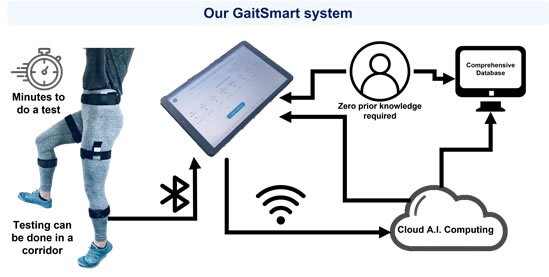
GaitSmart is a sensor-based clinical tool that provides an accurate assessment of a patient’s gait kinematics. Using a visual traffic light system and scoring, it presents easy-to-understand data for both clinicians and patients. This system not only identifies the severity and location of gait issues but also offers a personalised exercise rehabilitation program based on objective data. A healthcare assistant can administer the test in just 10 minutes, making it a highly efficient solution. Our four-session strength and balance program over 12 weeks has been shown to improve mobility and quality of life for patients with various MSK conditions.
All the evidence was independently reviewed and in recognition of its efficacy and economic viability, GaitSmart was awarded NICE Guidance in 2024 for Falls Prevention. GaitSmart is a Class 1m medical device, fully certified to be used in the UK, Europe, US and Canada.
How does GaitSmart work?
The quick and easy-to-use GaitSmart test can be administered by non-professional healthcare workers with minimal training, freeing up scarce physiotherapy resources. GaitSmart’s digital test results allow easy retrieval of patient information and the ability to track changes in mobility over time.
Step 1: Wireless Inertial Measurement Unit (IMU) sensors are attached to the individual.
Step 2: The individual walks 10strides while the sensors record the motion.
Step 3: The GaitSmart Report shows key gait kinematic parameters and overall GaitSmart Scores.
 The GaitSmart Report and Personalised Exercise Plan
The GaitSmart report shows the ranges of motion that the patient can achieve at their hip and knee joints, the amount of out-of-plane movement through adduction and abduction, as well as the symmetry of the lower limbs. Gait issues are highlighted in the GaitSmart Report with the severity being denoted by simple traffic light colour-coding. The GaitSmart Report also provides a personalised exercise programme to address the muscle weaknesses identified. This total solution empowers the individual and motivates them to perform their exercises at home.
GaitSmart in Clinical Practice
Traditional physiotherapy solutions, while effective, are often costly and resource-intensive and lack objective data to tailor treatments accurately. Unlike conventional methods and virtual physiotherapy apps, GaitSmart delivers precise, objective assessments and personalised exercise plans, filling a crucial gap in the market. This technology addresses the inherent challenges of monitoring gait and offers a complete solution that supports patient health and wellbeing.
GaitSmart represents a valuable treatment option that could also address a significant gap in gait rehabilitation services. Traditional rehabilitation often requires substantial time and skilled resources, which can limit accessibility for some patients. GaitSmart, delivered by trained healthcare assistants, offers a more accessible and less resource-intensive alternative. This is particularly beneficial for patients who may not otherwise have access to dedicated gait rehabilitation services due to logistical or financial constraints. Training healthcare assistants to deliver GaitSmart ensures that patients receive consistent and effective rehabilitation while maintaining a streamlined and cost-effective service delivery model. This is particularly beneficial in community settings where access to physiotherapists may be limited. The integration of GaitSmart within the NHS thus exemplifies a collaborative approach to healthcare delivery, optimizing the use of available resources and enhancing patient care.
In the UK alone, over 20 million people suffer from MSK conditions, including 8 million with osteoarthritis. Each year, more than 200,000 undergo joint replacements, and over 3 million people over 65 experience falls primarily due to poor gait. GaitSmart provides an invaluable tool for these individuals, offering a digital solution that surpasses the limitations of existing physiotherapy and digital health options.
Implementing GaitSmart
NICE Guidance [MTG78] states GaitSmart can be utilized to help adults at risk of falls, with gait and mobility issues. This is crucial as falls are a significant concern, with around 10.8 million people over 65 at risk of falls, of which around 3.3 million fall each year. Falls can lead to severe health complications, including fractures and reduced quality of life. GaitSmart offers a proactive approach to mitigating these risks by improving gait stability and mobility.
Recovering a normal gait after injury or surgery is crucial for maintaining mobility and overall health. Traditional gait monitoring, typically conducted in specialized gait laboratories, is often costly and time-consuming, limiting its accessibility to many patients and typically only those in the post-operative phase. This restricted access can result in suboptimal recovery for those undergoing knee and hip replacements, impacting their long-term health. GaitSmart offers a cost-effective and efficient solution that can be delivered both in clinics and the community. By providing accessible gait monitoring and intervention, GaitSmart supports not only post-operative recovery but also prevention and pre-operation care. This comprehensive approach ensures that individuals on waiting lists, as well as those undergoing preventive measures, receive the necessary support to maintain and improve their gait. Aligning with the NHS Long Term Prevention Programme, GaitSmart enhances patient outcomes across all stages of care, promoting better long-term health and mobility.
GaitSmart in the NHS
GaitSmart is supported by a decade of clinical trials. The published clinical evidence supporting GaitSmart has been collected from a range of NHS settings across primary, secondary, and community care. The evidence shows that GaitSmart can improve gait parameters and patient-reported outcomes for people over a very wide age range, including those with limited mobility and using a range of walking aids. It also provides greater independence to individuals whilst also reducing the burden on the NHS. As GaitSmart is a medical device with a digital component, it supports the NHS’s commitment to evidence-based practice. It also provides objective data that can be shared across primary, secondary, and community care, in a similar way to a simple blood pressure reading. This supports the ‘Integrated Care’ strategy and ensures a continuum of care for all patients.
By providing a proactive, data-driven approach to gait rehabilitation, GaitSmart not only improves patient outcomes but also represents a cost-effective solution for the NHS. Its integration into healthcare services marks a significant step forward in addressing the challenges of MSK conditions and enhancing patient care.
Content provided by Dynamic Metrics Ltd. For more information please visit www.dynamicmetrics.com.


